
Every January, the same conversation repeats across UK accounting firms: "It's busy season. What can you do?"
Staff work weekends. Partners pull late nights. Client communication slows. Errors creep in. And everyone accepts it as simply "the nature of the business."
But here's a question worth sitting with: What if busy season isn't a law of nature : but a symptom of operational neglect?
The deadlines are real. The volume is real. But the chaos? That's optional. And increasingly, forward-thinking firms are proving it.
The Tradition Trap: Why We Accept Busy Season
For decades, accounting has been shaped by fixed deadlines : Self Assessment in January, Corporation Tax, VAT quarters, year-end accounts. These create natural peaks in demand.
The traditional response has been simple: absorb it. Work harder. Sleep less. Apologise to your family.
This approach worked when firms were smaller, technology was limited, and client expectations were lower. But the profession has changed. Client volumes have grown. Regulatory complexity has increased. And yet : the operational model in most firms hasn't evolved.

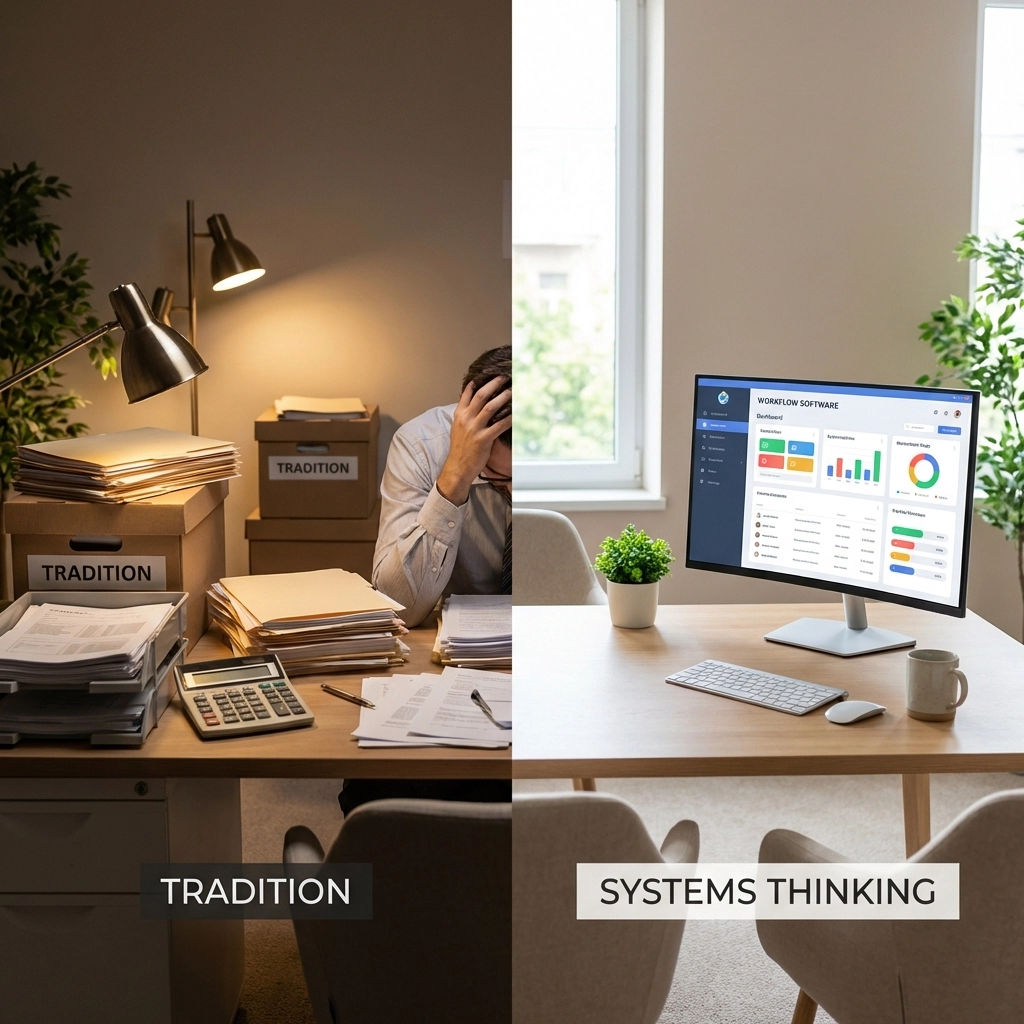
What you're left with is a business that runs smoothly for nine months and then falls apart for three. That's not a seasonal challenge. That's a structural weakness.
The uncomfortable truth is this: busy season exists because firms design their operations around tradition, not efficiency.
Systems Thinking: A Different Lens
Let's reframe the problem.
A "busy season" is essentially a mismatch between demand and capacity. Too much work, not enough people or hours to do it well. Classic bottleneck.
In manufacturing, logistics, or tech : industries obsessed with throughput : this kind of predictable demand spike would trigger immediate action:
- Pre-positioning resources
- Smoothing workflows across the year
- Automating repetitive tasks
- Building flexible capacity
In accounting? We just tell everyone to "push through."
But systems thinking offers another way. Instead of treating January as a sprint, you treat the entire year as a relay : with deliberate handoffs, pre-scheduled tasks, and capacity buffers designed into the model.
This isn't theory. Firms that invest in accounting workflow systems are already doing this : and they don't experience "busy season" the way traditional firms do.
Why Most Firms Stay Stuck
If the solution is so clear, why don't more firms adopt it?
Three reasons:
1. Identity
"Busy season" has become part of the professional identity. It's a badge of honour, a war story, a shared ritual. Letting go of it means letting go of something that defines the culture of many firms.
2. Short-Term Focus
Redesigning operations takes time and thought : both in short supply during peak periods. Firms keep saying, "We'll fix it after January." But after January comes recovery. Then summer. Then Q4 prep. And the cycle continues.
3. Lack of Systems Expertise
Most accountants are trained in compliance, not operations. Workflow design, capacity planning, and process automation aren't part of the syllabus. So even when firms want to change, they don't know where to start.
What Systems-First Firms Do Differently
Let's look at what actually changes when you move from tradition to systems.
Year-Round Client Engagement
Instead of chasing documents in December, systems-first firms collect data continuously. Monthly bookkeeping reviews, quarterly check-ins, and automated reminders mean the January workload is spread across the year.
This isn't about doing more : it's about doing it earlier. The total work stays the same. The panic disappears.
Clear SOPs and Delegation
When processes are documented, tasks can be delegated. When tasks can be delegated, senior staff aren't stuck doing data entry in January.
Firms with strong bookkeeping workflow optimisation don't rely on heroes. They rely on repeatable systems that anyone on the team can follow.
Flexible Capacity Models
Hiring full-time staff to handle a three-month spike makes no financial sense. But building flexible capacity : through trained offshore support, automation, or freelance specialists : does.
Many UK firms are now using outsourced bookkeeping support to scale up during demand peaks without carrying fixed overhead year-round. It's not about replacing your team : it's about protecting them.
Automation of Low-Value Tasks
Bank reconciliations. Data entry. Chaser emails. These tasks consume hundreds of hours every January : and most of them can be automated or semi-automated today.
According to ICAEW's guidance on technology adoption, firms that embrace automation report measurable improvements in both efficiency and staff wellbeing. It's no longer a "nice to have." It's a baseline expectation for modern practice.
The Real Cost of Doing Nothing
Let's be blunt about what "tradition" actually costs:
- Staff burnout and turnover. Talented people leave firms that can't protect their time.
- Client service gaps. Rushed work leads to missed opportunities and damaged trust.
- Profit leakage. Overtime, errors, and rework eat into margins : especially in fixed-fee models.
- Growth ceilings. If your team is maxed out every January, you can't take on new clients without breaking something.

The firms that treat busy season as "just how it is" are slowly bleeding capacity, reputation, and profit : and many don't even realise it.
How to Start the Shift
You don't need to overhaul everything at once. But you do need to start.
Here's a practical path forward:
-
Audit your January. What tasks consumed the most time? Which were avoidable with earlier preparation?
-
Document your workflows. If a process lives only in someone's head, it can't be improved, delegated, or automated.
-
Identify your bottlenecks. Where does work pile up? Who becomes the single point of failure?
-
Build flexible capacity. Whether through automation, outsourcing, or cross-training : create options beyond "work harder."
-
Shift client expectations. Start communicating earlier. Set deadlines that serve your workflow, not just theirs.
None of this is radical. It's just intentional.
A Challenge Worth Taking
Busy season isn't going away : but the chaos can.
The firms that thrive over the next decade won't be the ones that survive January. They'll be the ones that design it out of existence.
It requires a shift in mindset: from reactive to proactive, from tradition to systems, from endurance to engineering.
If your firm is tired of the annual scramble, maybe it's time to stop managing busy season : and start questioning whether it needs to exist at all.
FAQs
Is it realistic to eliminate busy season entirely in an accounting firm?
Eliminating all peaks may not be possible due to fixed regulatory deadlines. However, firms can significantly reduce the intensity by spreading preparation throughout the year, automating repetitive tasks, and building flexible capacity. The goal isn't perfection : it's control.
What's the first step to reducing busy season pressure?
Start by documenting your current workflows and identifying where time is lost to avoidable bottlenecks. Often, the biggest gains come from earlier client engagement and automating low-value admin tasks : not from hiring more staff.
If your team dreads January every year, the problem isn't the deadline. It's the system : or lack of one. We help UK firms build smarter workflows that spread the load and protect your people. Let's talk.