
You're booked out three weeks in advance. Your client base is growing. Revenue looks strong on paper. But here's the catch : you're spending 15 hours a week on data entry, meeting prep, and CRM updates instead of actually advising clients.
Sound familiar?
Most advisors hit this wall between $300K and $750K in revenue. You're too busy to grow, but hiring a full-time paraplanner feels like a leap you're not ready to make. The question isn't whether you need help : it's whether you should outsource paraplanning services or bring someone in-house.
Let's break down when each option makes sense, what the real costs look like, and how to know which path fits your firm.
The Breaking Point: Busy But Not Growing
Most RIAs don't realize they've hit capacity until they start turning down referrals or delaying client reviews. The work keeps coming, but your calendar is gridlocked with backend tasks that don't require your CFP.
Here's what the "breaking point" usually looks like:
- You're spending more time in Redtail or eMoney than in client meetings
- Meeting prep takes 2–3 hours per client
- Follow-up emails and action items stack up for days
- You're working evenings just to keep up with plan updates
- New client onboarding feels like a project, not a process
This is the stage where most advisors start Googling "financial advisor admin support" or "RIA back office support" at 11 PM. The pain is real, but the solution isn't always obvious.

The truth? You don't always need a full-time hire to solve a capacity problem. Sometimes you just need the right support structure : and that's where outsourcing starts to make more sense than hiring locally.
The Real Cost of Hiring In-House vs. Outsourcing
Let's talk numbers, because this is where most advisors get stuck.
In-House Paraplanner: The Full Picture
Hiring a junior paraplanner in the U.S. typically costs:
- Salary: $45K–$65K annually (depending on location and experience)
- Benefits: Health insurance, 401(k) match, PTO : add 20–30% on top of salary
- Overhead: Desk space, software licenses, training time
- Management time: Onboarding, delegation, performance reviews
Total annual cost: $60K–$85K+, plus 10–15 hours/month managing them.
And here's the kicker : if your workflow isn't clean, that hire won't solve the problem. They'll just inherit your chaos.
Outsourced Paraplanning: Predictable and Scalable
With outsourced support, you're typically looking at:
- Retainer model: $1,500–$3,500/month for 20–40 hours of dedicated support
- Per-task pricing: $50–$150 per deliverable (plan summaries, meeting prep, CRM updates)
- No benefits, no overhead, no management burden
Annual cost: $18K–$42K, with flexibility to scale up or down based on your firm's needs.
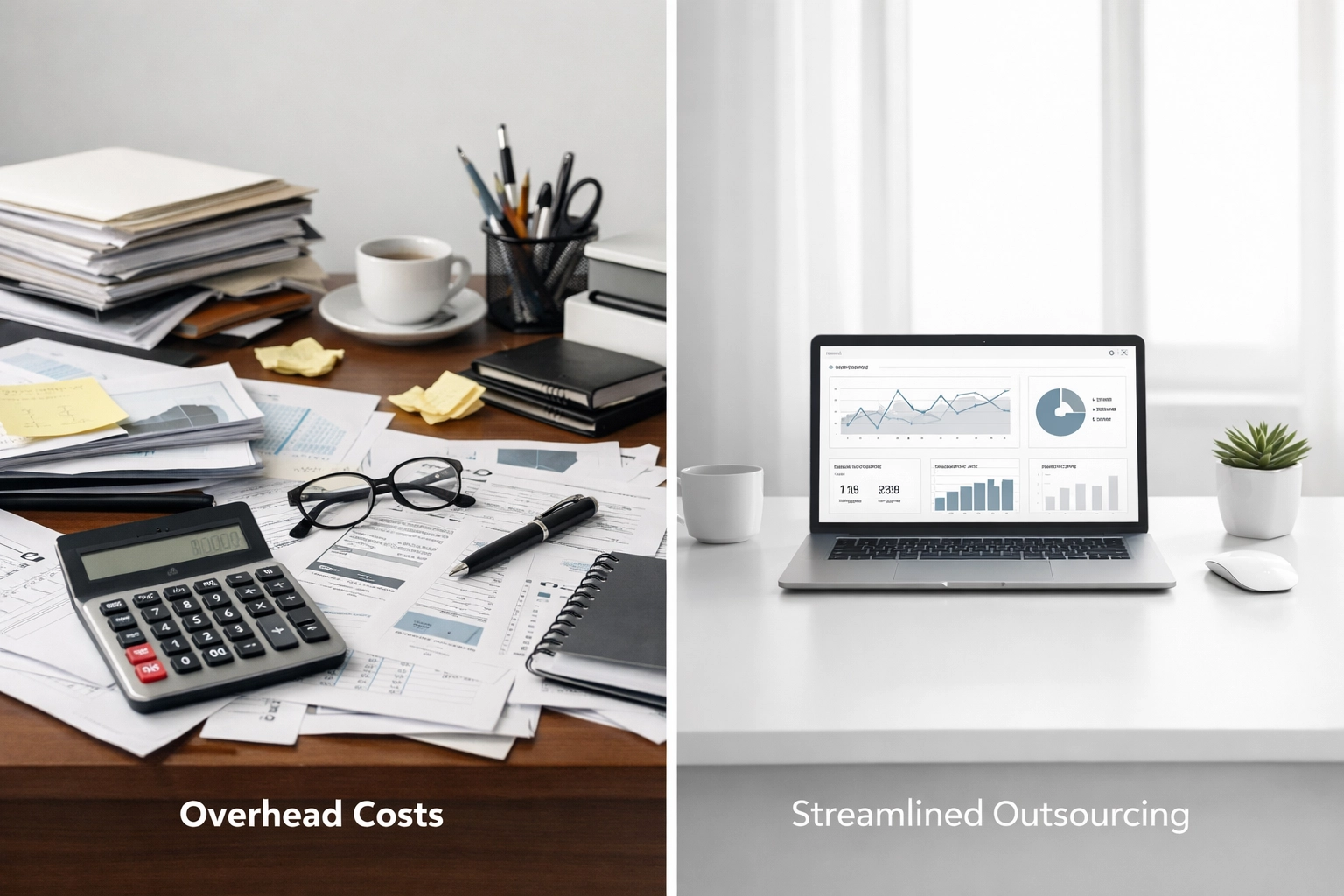
The difference isn't just financial. It's operational. Outsourcing gives you RIA back office support without the long-term commitment, and you're working with specialists who've done this for dozens of firms : not someone learning on your dime.
Integration: Plugging Into Your Existing Workflow
One of the biggest concerns advisors have about outsourcing is whether it'll actually work with their existing tools. The good news? Most outsource paraplanning services are built to integrate with the platforms you're already using.
At The CollabHub, our team plugs directly into:
- Redtail CRM for task management, client notes, and workflow tracking
- eMoney for plan creation, scenario modeling, and updates
- Wealthbox, Salesforce, or other CRMs depending on your setup
- Slack, Teams, or email for communication
We're not asking you to change your tech stack or adopt new software. We adapt to how you already work : whether that's detailed SOPs or a "figure it out as we go" approach. The goal is to reduce friction, not add it.
The key difference between hiring in-house and outsourcing here is speed. An in-house hire needs weeks (or months) of onboarding. Outsourced support? You're typically up and running in 7–10 days.
The Benefit of Dedicated Specialists Who Adapt to Your Style
Here's something most advisors don't think about: not all paraplanning is the same.
Some firms focus heavily on tax-efficient withdrawal strategies. Others specialize in executive comp or equity planning. Your clients, your planning philosophy, and your communication style are unique : and your support team needs to reflect that.
When you outsource, you're not just getting task completion. You're getting:
- Specialists who've worked across multiple RIAs, so they bring best practices from other firms
- Dedicated support that learns your voice, your templates, and your client preferences
- Scalable capacity : if you take on 10 new clients in Q2, your support scales with you
One of our clients, a solo RIA in Austin, put it this way: "I didn't want someone who just knew eMoney. I needed someone who understood how I talk to clients and could draft follow-ups that sounded like me."
That's the value of financial advisor admin support done right. It's not just delegation : it's partnership.
Scalability: Adjusting Support as Your Firm Grows
Let's say you hire an in-house paraplanner. Six months later, you realize you don't have 40 hours/week of work for them. Or maybe the opposite happens : you grow faster than expected and now you need two people.
With an employee, you're locked in. With outsourcing, you adjust.
Here's how scalability works in practice:
- Start small: Outsource meeting prep and CRM updates for 10–15 hours/month
- Test the fit: See if the support style and quality match your standards
- Scale up: Add plan creation, client onboarding, or compliance tracking as needed
- Flex down: During slow months (hello, January), you're not paying for unused capacity
This flexibility is especially valuable for firms that are scaling RIA operations but aren't sure what their staffing needs will look like in 12–18 months. Outsourcing gives you room to grow without overcommitting.

So When Should You Hire In-House?
Outsourcing isn't always the answer. Here's when hiring an in-house paraplanner makes more sense:
- You have 30+ hours/week of consistent paraplanning work and can justify a full-time role
- You want someone embedded in your office culture and client relationships long-term
- You have strong workflows and training systems already in place
- You're ready to manage someone : onboarding, performance reviews, career development
If you check all those boxes, hiring locally might be the right move.
But if you're still building systems, testing capacity, or unsure whether you need someone full-time? Outsourcing gives you a lower-risk way to solve the problem today without locking yourself into a long-term commitment.
Key Takeaways: How to Decide
Here's a quick framework:
Choose outsourcing if:
- You're between $300K–$1M in revenue and capacity is your biggest bottleneck
- You need support now but don't have 40 hours/week of work
- You want predictable costs without benefits, overhead, or management time
- You value flexibility and want to scale support up or down
Choose in-house if:
- You have 30+ hours/week of consistent work
- You're ready to invest in training, management, and long-term development
- You want someone physically present in your office
- Your workflows are clean and documented
Not sure? Start with outsourcing for 3–6 months. Test the model. If it works, keep going. If you outgrow it, you'll have cleaner processes and a better sense of what an in-house hire should actually do.
Final Thoughts
Most advisors don't struggle with planning : they struggle with bandwidth. And the smartest way to solve that problem isn't always adding headcount. Sometimes it's finding the right support structure that fits where your firm is today, not where you hope it'll be in three years.
If your firm is feeling the strain of admin work and you're spending more time in your CRM than with clients, outsourcing might be the path that gets you unstuck. We help advisory teams streamline meeting prep, follow-ups, and backend tasks : so you can focus on planning, not paperwork.
Your time should be spent on advice, not admin. We'll handle the rest quietly.
About the Author
Mohammad Aamish Aaftab is the Founder of The CollabHub, a consulting and back-office support firm helping US Financial advisory firms streamline operations, strengthen client delivery, and scale sustainably.
With years of experience working with global firms across the U.S., U.K., and U.A.E., Aamish has built a reputation for turning inefficient workflows into efficient, scalable systems. His focus lies in helping firms operate smarter : not harder : by designing backend processes that reduce overwhelm, save time, and improve profit margins.
Aamish combines his background in financial planning, business operations, and process consulting to help accounting leaders regain clarity, consistency, and control in their practice : so they can focus on what truly matters: their clients and their long-term growth.